
The guide is the practical companion to leading AI in colleges and universities, our strategic framework for senior leaders.
How to use this guide
You have probably moved past the early questions and the early stages of the AI maturity model. Most colleges and universities are no longer asking whether to use AI, or running their first pilots — they are working out how to make it operational and embedded across the institution, consistently and safely.
That is what this toolkit is for. Where our leading AI in colleges and universities guide sets out the small number of decisions only senior leaders can make, this is the detail for the people delivering: heads of function, digital and AI leads, and practitioners.
Where this sits on the AI journey
Our maturity model describes the whole path — from approaching and understanding, through experimenting, to operational, embedded and finally optimised or transformed. The first stages are about getting started; most of the sector has moved through them. This guide is about the rest: how you embed AI well and keep improving.
The guide is built around the three pillars of responsible adoption — skills, knowledge and culture; technology; and governance — with the strategic direction leaders set above them, and two foundations, data maturity and security, beneath. Work through the pillar most relevant to you. Within each, these later stages of the maturity model help you locate where you are:
| Operational | Embedded | Optimised or transformed |
|---|---|---|
| Activity is real but uneven — in pockets, not yet consistent. | Consistent, supported and institution-wide. | AI significantly changes how the institution works and is continually refined. |
A note for universities: this is a combined guide for higher and further education. The three pillars and most of the detail apply to both. Where something applies mainly to universities — research being the clearest case — we flag it “in universities” so college readers can skim past.
Where to start
We believe each of the pillars is of equal importance, and should be tackled in parallel. There will of course be some natural order that things should be done - data protection policies for AI should be reviewed before pilots start, for example, and the technology needs to be chosen before hands-on training can be provided.
That doesn’t mean though that one pillar should be perfected before moving on to tackle the next. The exact order will depend on your priorities, but the interconnection of these will be something you are used to from any other technology project - AI isn’t a special case for this. Connections and order aren’t, therefore, spelt out in detail in this guide.
The framework at a glance
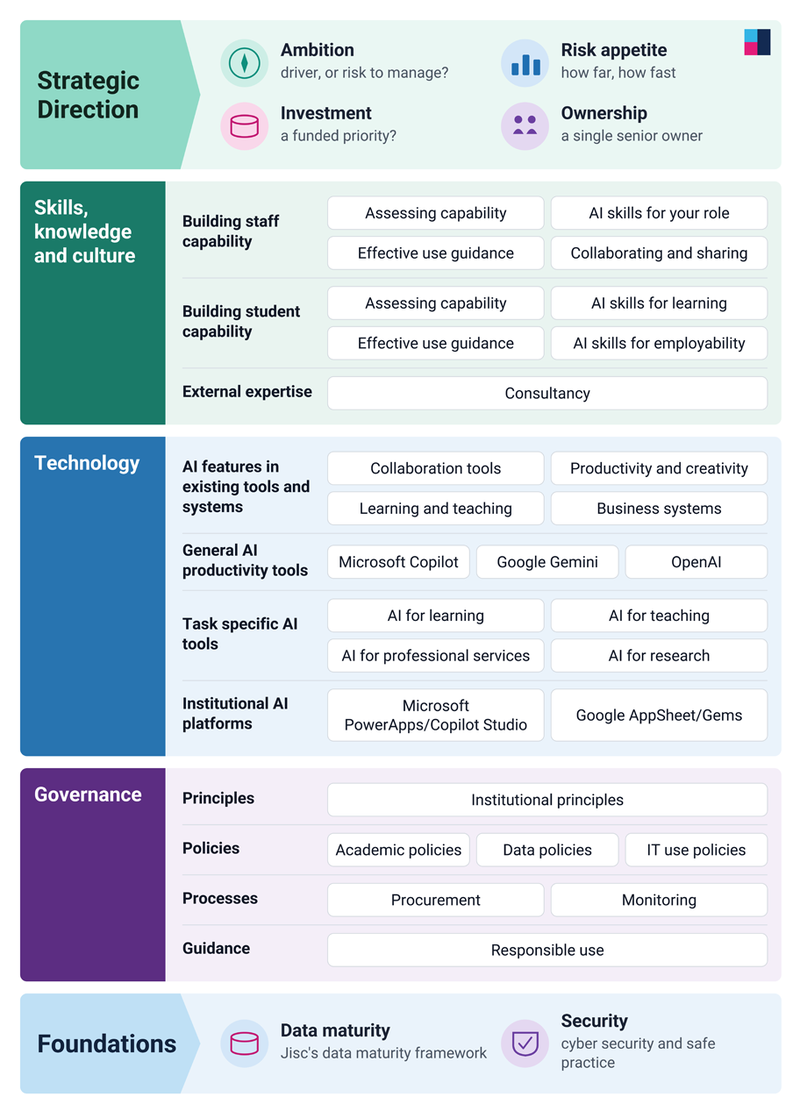
Open a larger version of the three pillars infographic (png).

Alt text for the strategic framework infographic
AI strategic framework: three pillars
The framework is organised into three pillars: skills, knowledge and culture; technology; and governance. All three pillars are underpinned by data maturity.
Skills, knowledge and culture
Building staff capability
- Assessing capability
- AI skills for your role
- Effective use guidance
- Collaborating and sharing
Building student capability
- Assessing capability
- AI skills for learning
- Effective use guidance
- AI skills for employability
External expertise
- Consultancy
Technology
AI features in existing tools and systems
- Collaboration tools
- Productivity and creativity
- Learning and teaching
- Business systems
General AI productivity tools
- Microsoft Copilot
- Google Gemini
- OpenAI
Task specific AI tools
- AI for learning
- AI for teaching
- AI for professional services
- AI for research
Institutional AI platforms
- Microsoft PowerApps/Copilot Studio
- Google AppSheet/Gems
Governance
Principles
- Institutional principles
Policies
- Academic policies
- Data policies
- IT use policies
Processes
- Procurement
- Monitoring
Guidance
- Responsible use
Data maturity
Data maturity underpins all three pillars, with reference to our data maturity framework.
The strategic direction
Above the three pillars sits the strategic direction that only senior leaders can set — the institution’s ambition for AI, its risk appetite, whether AI is a funded priority, and who owns it.
These are the subject of our companion guide, leading AI in colleges and universities, and they shape everything in this guide: the pace you can work at, the risk you can carry, and the resources you have to hand.
Where that direction is unclear, surface it early — delivery stalls when the strategic layer is left unspoken. The wider context that bears on these decisions — why AI adoption now has to be justified, not just achieved — is set out there too.
Pillar one: skills, knowledge and culture
Across the sector, the technology is rarely the barrier — staff confidence is. Where people feel unsure or excluded, tools are underused, misapplied or resisted. Where they feel supported and trusted, AI saves time, enriches learning and improves the student experience. Embedding AI is, more than anything, a capability and culture challenge.
Be strategic: build on what exists
There is no need to start from scratch. Our structured AI literacy curriculum gives all staff a baseline of understanding, practical application and ethical awareness. It runs online or as modules embedded into CPD, and can be the foundation for your own internal programme. Once staff have confidence, they can work out how best to use AI in their own discipline — and communities help them learn from others rather than reinventing the wheel.
Core AI skills for staff
Start by assessing capability, then provide role-specific paths through structured training, guidance on responsible use, and opportunities to collaborate and share.
| Assessing capability | Responsible AI guidance | AI skills for your role | Collaborating and sharing |
|---|---|---|---|
| Benchmark current digital skills; identify strengths and gaps. | Offer clear, accessible guidance on responsible AI use. | Provide structured training tailored to role and experience. | Encourage staff to learn from peers and sector practice. |
| Capability: our building digital capability service. | Staff AI guidance: our sample staff AI guidance to adapt. | Training: our AI literacy courses and online modules. | Communities: our AI communities. |
Core AI skills for learners
The learner approach mirrors staff — assess capability, guide on responsible use — but skills split into two distinct needs. AI for learning can be provided centrally, like other study skills. AI for employability must be tailored to the discipline and embedded in the course.
| Assessing capability | Responsible AI guidance | AI for learning and employability | Embedding in the curriculum |
|---|---|---|---|
| Capability: our building digital capability service. | Learner AI guidance: our sample learner AI guidance to adapt. | Learner resources: community-created resources. | Industry-relevant AI skills embedded in the curriculum. |
In universities: treat researcher AI literacy as a strand in its own right — AI in the research lifecycle, research-specific tools, and the integrity questions that come with them.
Critical AI literacy
Embedding is not only about using tools well. As AI becomes contested — over environmental cost, data ethics, jobs and reliability — staff and learners increasingly need to evaluate AI critically, not just operate it. Build this into your offer. There are many different frameworks and approaches to this. As an example, the approach we adopt in our training embeds four questions:
- What is the tool actually doing? What has it been designed to do, what it’s working from, what does its output represent, and what are its limitations
- Who benefits and who is disadvantaged? Who benefits from a particular application of AI, who may be excluded or disadvantaged, whose perspectives are represented, and whether existing inequalities are being reduced, reproduced or amplified
- Who controls it? Who develops and owns a system, who determines how it operates, whose values and assumptions influence it
- What changes when we use it? What changes within an institution, including roles and processes; and what changes more widely, including employment, inequality, environmental impact and society’s relationship with technology
The payoff
When staff are AI-confident, the institution gains on multiple fronts: use is intentional, well informed, and appropriate to the task or process in hand. AI use is modelled for students in responsible ways. Above all it builds a culture open to innovation but grounded in good practice — the foundation every investment in technology and governance rests on.
Quick checklist for delivery teams
- Do staff and learners have access to a capability-assessment tool (eg our building digital capability service)?
- Is there a structured programme of staff AI training — with protected time to explore and experiment?
- Does that training build the skills to critically evaluate AI use, not just operate the tools?
- Has clear staff and learner guidance on responsible use been produced — refreshed regularly and built into induction and CPD?
- Do you have a network of AI champions, share good practice, and take part in our AI community groups?
- Is completion of core AI literacy encouraged across the institution?
- Are AI skills for employability embedded in the curriculum, with employer feedback informing them?
- In universities: is there a distinct AI-skills path for researchers?
Useful resources
Follow the question you’re asking down into the detail.
How do we know where our staff and learners are?
- Our building digital capability service can help you assess current AI capability for staff and learners and identify gaps
How do we build staff AI skills for their roles?
- AI literacy curriculum for teaching and learning staff: a ready-made, structured programme to build from
- AI literacy curriculum for professional services staff: the equivalent for professional teams
- AI literacy training: our live sessions, included in membership, if you’d rather book than build
What guidance do staff and learners need for responsible use?
- Sample staff AI guidance: a template to adapt for your staff
- Sample learner AI guidance: the equivalent for students
How do we share practice and get outside help?
- Our AI community: connect and share across the sector (teaching and learning, professional services, research)
Understanding the landscape
Build critical literacy
Know the mood
- Staff perceptions of AI 2025
- Student perceptions of AI 2025
- Skills in an AI age: a UK-wide view of the challenges ahead
From the sector
These resources were shared or presented in our community sessions.
Milton Keynes College: embedding AI literacy end to end
- Building AI literacy into schemes of work and a half-termly quality scorecard aligned to Ofsted
- A careful Copilot-for-13+ rollout with an ethics board consent and safeguarding testing
- “Everything AI” spaces for staff and students
- How they build and test Copilot Studio agents, including the “cheesecake test” for checking an agent is locked to its knowledge base
AI in FE: hands-on AI literacy, agents and cheesecake with Milton Keynes College
Kirklees College: a whole-organisation, inclusive approach
How the college gave everyone, from governors to catering staff, access to AI training and resources; used deliberately inclusive language to lower barriers; and grew the culture through staff communities — the monthly CreAItive Club, the cross-sector AI Collaboration (AIC) group, and its annual TechTober.
FE community meetup – leading an inclusive approach to AI adoption with Kirklees College
University of Northampton — embedding AI into a discipline (fashion education)
An educator’s account of weaving generative AI through the fashion curriculum, so students gain the industry-relevant, employable skills their sector now expects.
An educator’s account of weaving generative AI through the fashion curriculum, so students gain the industry-relevant, employable skills their sector now expects.
University of York — a whole-institution approach to AI in teaching and assessment
York has adopted the Russell Group principles, set a policy on acceptable assistance with assessments (adding a new “false authorship” misconduct offence), and made the data-protected Google Gemini its recommended institutional tool, with clear staff and student guidance.
University of York: generative AI enhanced teaching and learning
University of Sheffield: practical GenAI study-skills guidance
A student-facing hub on using generative AI responsibly across assessment, essays, revision, productivity, reading and note-taking, image generation and assistive technology, with an academic prompt bank.
University of Sheffield: practical GenAI study-skills guidance
A student-facing hub on using generative AI responsibly across assessment, essays, revision, productivity, reading and note-taking, image generation and assistive technology, with an academic prompt bank.
University of Sheffield: practical GenAI study-skills guidance
London Metropolitan University: a library-led AI guide
From the academic liaison librarians: AI tools, prompting (“how to ask AI”), academic integrity, using AI critically, verifying and citing outputs, and AI ethics.
From the academic liaison librarians: AI tools, prompting (“how to ask AI”), academic integrity, using AI critically, verifying and citing outputs, and AI ethics.
University of Northampton: students as partners in AI literacy
Through the StudySmart2 project, students created posters and video reflections on using AI in everyday study — from wellbeing and personalised learning to cultural awareness and boosting English — a good example of involving learners in building the resources, not just receiving them.
Through the StudySmart2 project, students created posters and video reflections on using AI in everyday study — from wellbeing and personalised learning to cultural awareness and boosting English — a good example of involving learners in building the resources, not just receiving them.
From other agencies (shared by members)
Pillar two: technology
From planning and marking to student support and everyday admin, the right AI tools can save time and enhance the student experience. The challenge is knowing which to trust and which add value — which is where Jisc identifies, tests and negotiates licences for tools that are safe, effective and affordable for the sector.
First: be problem-focused
Before thinking about tools, focus on the problems you want to solve, not the technology. Tools should be chosen to address real challenges — and AI won’t be the right answer to every one.
It is easy to be dazzled by impressive technology and then hunt for a use; that is the wrong way round. Ask what the biggest challenge actually is — a recruitment bottleneck, staff workload, a specific part of the learner experience — and start there.
And, in teaching and learning, be pedagogically justified. When AI is used in the learning process itself, being problem-focused means more than saving time. Be clear why you are using it:
- Are we clear what we are using it for, and why here?
- Is the approach grounded in sound pedagogical principles?
- What evidence is there that it will actually benefit learning?
Educational purpose, not novelty, should decide whether AI belongs in the learning process.
Be strategic: reuse and partner, don’t build
It is almost always better to adopt proven solutions than to build your own.
In order of preference: use what you already license (review your tools and suppliers’ roadmaps); use a general-purpose tool such as Microsoft Copilot or Google Gemini, often with training: partner with a trusted supplier, in many cases through a Jisc agreement.
Building your own is a challenge too far for most institutions — robust, secure software is costly to build and maintain, and threats keep evolving. For custom workflows, use the automation platforms in your cloud environment (PowerApps/Copilot Studio, AppSheet/Gems), which come with built-in security and governance.
Core AI tools for learners
| General-purpose AI | Institutional AI assistant | Tools for learning | Tools for employability |
|---|---|---|---|
| Guided access lets learners practise real-world skills. | A 24/7 assistant for institutional life. | Support for independent study and success. | Industry-standard tools embedded in courses. |
| LearnWise (through Chest) |
|
|
Core AI tools for learners
| General-purpose AI | Institutional AI assistant | Tools for teaching | Tools for professional services |
|---|---|---|---|
| Secure, policy-aligned use with data safeguards. | A 24/7 assistant for staff. | Improve efficiency and support for learners. | Support administration and leadership. |
| LearnWise |
|
|
In universities: AI is increasingly part of the research lifecycle. Choose research tools with the same reuse-and-partner discipline, and pay particular attention to data confidentiality, reproducibility and research integrity.
Tools and licences available through Jisc
Specific tools referenced above, available or piloted through Jisc:
- Adobe Firefly introduction guide and Adobe Firefly licence agreement
- Bodyswaps pilot report and Bodyswaps licence agreement
- FeedbackFruits pilot report (pdf) and FeedbackFruits licence agreement
- Google AppSheet: City College Plymouth case study
- Graide pilot report and Graide latest pilot
- LearnWise pilot report and LearnWise licence agreement
- Microsoft PowerApps is available through our cloud services
- TeacherMatic pilot report (pdf) and TeacherMatic licence agreement
The payoff
A coherent, trusted toolkit pays off across teaching, learning and operations. Staff save time on routine work and focus on higher-value activity.
Learners gain confidence with the same tools they’ll meet in the workplace or in higher study. Institutions see greater consistency, reduced risk and stronger alignment between practice and strategy.
Quick checklist for delivery teams
- Are you piloting AI features in tools you already license (collaboration, productivity, VLE, business systems) before buying new?
- Have you piloted general-purpose tools, and is it clear which one staff should use?
- Do you provide a consistent, trusted core toolkit rather than fragmented, unassured adoption?
- Is adoption judged on its impact on workload, quality and the learner experience?
- Do you have task-specific tools embedded where they add value — teaching, learning and professional services?
- Are you aware of your key suppliers’ AI roadmaps, and do you review the tools in use regularly?
- Are accessibility needs considered, and are you working to minimise disadvantage from unequal access to paid tools?
- Are you making use of Jisc-negotiated licences and pilots for value and early access?
Useful resources
Follow the question you’re asking down into the detail.
“How do we know when to use AI tools?”
- Where AI fits — insights from an AI impact workshop: a method for finding where AI actually helps, problem-first
- AI in professional services: purpose first, product second
“How do we bring in a chatbot or assistant?”
- Implementing chatbots — a practical guide (LearnWise pilot)
- LearnWise end-of-pilot report: what the full pilot found
“How do we use AI in marking and feedback?”
- Insights from the AI in Marking and Feedback Pilot
- AI in Marking and Feedback Pilot – good practice case studies: Kirklees College
- AI in Marking and Feedback Pilot – good practice case studies: London South Bank University
- EduMark AI: A generative AI marking and feedback solution from Queen Mary University of London (QMUL)
“How can AI support accessibility and inclusion?”
- Navigating the intersection of AI, accessibility and education: Helen Nicholson-Benn on where AI genuinely helps disabled learners, and where to take care
- AI, accessibility and inclusion — insights from our roundtables: themes from cross-sector discussions
- Using AI thoughtfully to explore inclusion and flexibility in learning design: the inclusive learning-design angle.
From the sector
These resources were shared or presented in our community sessions.
Bradford College: AI-supported coding for richer content
Clark Mitton (digital experience design lead) on moving beyond click-through quizzes to immersive, AI-built activities — including a digital-safety simulator that mimics grooming-style chat scenarios for students to practise spotting — with a candid look at what makes it safe and effective.
AI in FE: exploring AI supported coding with Bradford College
Riverside College: a Copilot workflow with real impact
Craig Scott, a welding tutor, shows a practical, data-secure workflow: using the college’s licensed Copilot to distil dense awarding-body material, prioritise what to teach, and build focused resources for an online exam.
AI in FE: an AI assisted workflow with real impact from Riverside College
Craig Scott, a welding tutor, shows a practical, data-secure workflow: using the college’s licensed Copilot to distil dense awarding-body material, prioritise what to teach, and build focused resources for an online exam.
AI in FE: an AI assisted workflow with real impact from Riverside College
South Devon College: the Turing Tutor
Daniel Tagg on co-designing a student chatbot with learners and staff that shifted from detecting AI use to teaching good use, giving real-time feedback framed by the AI assessment scale.
Daniel Tagg on co-designing a student chatbot with learners and staff that shifted from detecting AI use to teaching good use, giving real-time feedback framed by the AI assessment scale.
Gloucestershire College: AI as assistive technology for SEND
Freya Bevan on using generative AI to bridge gaps in access, and to build independence and confidence for SEND learners.
AI in FE: AI as assistive technology for SEND learners with Gloucestershire College
Freya Bevan on using generative AI to bridge gaps in access, and to build independence and confidence for SEND learners.
AI in FE: AI as assistive technology for SEND learners with Gloucestershire College
Activate Learning: an in-house AI suite, done responsibly
Award-winning (Learning Awards Gold) in-house tools — ALIA, their intelligent assistant, plus Maths and English AI tutors and a feedback assistant — built on a clear AI usage policy, “AI breakfast” staff training, and a strong data-security and bias focus. A useful counterpoint on when building your own can work.
FE community meetup – Activate Learning’s in-house AI innovation
Blackboard Learn Ultra’s AI design assistant: Westminster and Northumbria
A case study of two universities using the AI built into their VLE to speed up course design.
A case study of two universities using the AI built into their VLE to speed up course design.
From the pilots
We pilot promising AI tools with members and publish the findings — independent, cross-sector evidence to draw on:
TeacherMatic: generating teaching resources
Reports from pilots in both further education and higher education (seven HE institutions) of a tool that helps staff generate lesson and assessment materials.
Reports from pilots in both further education and higher education (seven HE institutions) of a tool that helps staff generate lesson and assessment materials.
LearnWise: an institutional AI assistant
The end-of-pilot report on a student and staff support chatbot piloted across colleges and universities.
The end-of-pilot report on a student and staff support chatbot piloted across colleges and universities.
AI in marking and feedback
An ongoing pilot of marking and feedback tools (Graide, TeacherMatic) and general-purpose AI across 30+ colleges and universities.
An ongoing pilot of marking and feedback tools (Graide, TeacherMatic) and general-purpose AI across 30+ colleges and universities.
AI image generation
Guidance on AI Image Generation: learnings from our pilot of tools such as Adobe Firefly and Canva in education.
Guidance on AI Image Generation: learnings from our pilot of tools such as Adobe Firefly and Canva in education.
Pillar three: governance
Where governance is weak, AI use fragments, exposing staff and students to risks around data, fairness and trust. Where it is strong, AI is explored with confidence and the institution builds credibility. Governance is not bureaucracy — it is the foundation that lets you innovate safely.
Be strategic: guidance over a standalone AI policy
AI may feel new, but your existing academic, data and technology policies probably already cover the main points. In most cases you do not need a separate AI policy — a standalone one forces users to judge whether a feature “involves AI”, which is rarely clear, and risks duplicating or contradicting what you have.
Instead, review the policies you hold and focus effort on clear, user-friendly guidance: tell students how they can use AI appropriately, give staff practical guidance on keeping data secure, and help everyone ensure their use is responsible and aligned with your values.
| Principles | Policies | Procedures | Guidance |
|---|---|---|---|
| A top-level statement of your approach. | Review and adapt existing policies. | Review procurement and monitoring of AI systems. | Expand AI literacy to cover safe, ethical use. |
| AI principles: the Jisc/AoC principles for the use of AI in FE colleges |
|
|
|
In universities: governance extends to research integrity — AI in research design, analysis and authorship, and the ethics approvals that go with it — and to the standards and integrity of your provision, including any degree-awarding powers. These are senior-level positions; the strategic framework’s decision on academic standards points here for the detail.
The payoff
Robust governance benefits the whole institution. Staff and students gain clarity and confidence. Leaders innovate safely, assured risks are managed and reputation safeguarded. And the institution builds trust with learners, parents, employers and partners by demonstrating responsible, transparent adoption aligned with sector standards.
Quick checklist for delivery teams
- Do you have institutional AI principles setting the vision — owned by a cross-functional group and reviewed annually?
- Have you reviewed and updated academic, data and IT-use policies for AI (integrity, IP, acceptable use), with technical enforcement where needed?
- Are policies clear, unambiguous and usability-tested with staff and learners?
- Are pre-procurement criteria in place so AI tools come with information on how they work and use data — and don’t disadvantage learners?
- Do you monitor AI tools for performance and integrity, with regular reviews of policy and guidance?
- Is responsible-use guidance up to date, clearly signposted and visible to all — including how learners can contest an AI decision?
- Are staff and learners told how, when and why AI is used, and when their data might be used for model training?
- In universities: are research-integrity and academic-standards implications explicitly owned?
Further resources
Follow the question you’re asking down into the detail.
“What principles should we set — and how do we make them real?”
- Jisc/AoC principles for the use of AI in FE colleges: a sector-agreed starting point
- Navigating HE policies and guidance on generative AI: how HE institutions have approached theirs
“How do we protect academic integrity and rethink assessment?”
- AI detection and assessment — a 2025 update: where detection stands and why assessment design matters more
- FE AI and assessment top tips and the assessment Menu: practical ways to redesign assessment
- University of Nottingham — a blind-study evaluation of AI in assessment design: rigorous evidence on what AI can and can’t do
“How do we keep data safe and meet our obligations?”
- Using GDPR as a foundation for AI governance: build on what you already have
- AI and data security — worry about the right things: a sense of proportion on the real risks
- Navigating the terms and conditions of generative AI: reading the small print
“How do we procure and monitor AI responsibly?”
- AI procurement due diligence: sample questions to ask any supplier
- Resisting restrictive AI clauses in licences: protecting your data and rights
“What about safeguarding and age limits?”
- AI and safeguarding — a layered approach: where AI safeguarding responsibilities sit
- Age restrictions and consent: the tool age limits that catch institutions out
“How do we bring our governors and board with us?”
- Generative AI for college and university governors: a primer for the people providing oversight
From the sector
These resources were shared or presented in our community sessions.
Falmouth University: principles into everyday practice.
With a refreshingly explicit institutional position — engaging with AI is a personal choice, and principles exist to safeguard people and the integrity of creative work rather than to drive adoption — the digital learning team turned that stance into a repeatable method: a short series of workshops, a month-long role-specific pilot, and a structured “keep/explore/stop” evaluation producing artefacts other teams can reuse.
With a refreshingly explicit institutional position — engaging with AI is a personal choice, and principles exist to safeguard people and the integrity of creative work rather than to drive adoption — the digital learning team turned that stance into a repeatable method: a short series of workshops, a month-long role-specific pilot, and a structured “keep/explore/stop” evaluation producing artefacts other teams can reuse.
Coleg Cambria: a whole-institution AI framework
Nigel Holloway on an AI adoption framework underpinned by a monthly AI and digital strategy group, staff and learner guidance, participation in the Welsh-Government-funded Project Icarus, and the college’s first internal AI audit.
Nigel Holloway on an AI adoption framework underpinned by a monthly AI and digital strategy group, staff and learner guidance, participation in the Welsh-Government-funded Project Icarus, and the college’s first internal AI audit.
Gloucestershire College: beyond the hype
Ryan Molyneux on practical AI strategy: an AI policy built from Ofsted, JCQ and our AI maturity model; pilots of image-generation tools and a LearnWise chatbot; a new AI assessment scale pilot; and a staff AI literacy programme.
FE community meetup – beyond the AI hype with Gloucestershire College
Ryan Molyneux on practical AI strategy: an AI policy built from Ofsted, JCQ and our AI maturity model; pilots of image-generation tools and a LearnWise chatbot; a new AI assessment scale pilot; and a staff AI literacy programme.
FE community meetup – beyond the AI hype with Gloucestershire College
From universities and colleges (shared by members)
University of Sydney: the “two-lane” approach to assessment
The sector’s most-cited model: lane one is secured, in-person assessment of learning (orals, vivas, exams) that validates outcomes with AI controlled; lane two is open assessment for and as learning where AI use is scaffolded and taught. Sydney pairs it with program-level design so learning is assured at key points across a degree, rather than policed in every task.
Explore Sydney’s program level assessment design and the two-lane approach
Imperial College London: deciding how to approach AI on your module
A practical decision aid in Imperial’s teaching toolkit that helps staff choose, module by module, whether and how AI use is allowed — rather than applying one blanket rule.
View Imperial’s make a decision on how to approach AI on your module toolkit.
A practical decision aid in Imperial’s teaching toolkit that helps staff choose, module by module, whether and how AI use is allowed — rather than applying one blanket rule.
View Imperial’s make a decision on how to approach AI on your module toolkit.
Sheffield Hallam University: AI and assessment
Student-facing guidance setting out acceptable use of AI in assessment and how it relates to academic conduct, including its artificial intelligence transparency scale (AITS).
View Sheffield Hallam’s artificial intelligence and assessment guidance
Student-facing guidance setting out acceptable use of AI in assessment and how it relates to academic conduct, including its artificial intelligence transparency scale (AITS).
View Sheffield Hallam’s artificial intelligence and assessment guidance
University of Leicester: a published institutional AI policy
A concise, public university AI policy — a useful worked example of the top-level position this pillar calls for.
A concise, public university AI policy — a useful worked example of the top-level position this pillar calls for.
Ulster University: a GenAI hub for staff and students
From the Centre for Quality Enhancement: Ulster’s institutional position on GenAI, guidance for staff and students, an AI community of practice, and quick guides on academic practice, accessible AI imagery and responding to suspected misuse.
From the Centre for Quality Enhancement: Ulster’s institutional position on GenAI, guidance for staff and students, an AI community of practice, and quick guides on academic practice, accessible AI imagery and responding to suspected misuse.
From other agencies (shared by members)
The foundations: data maturity and security
The three pillars rest on two foundations — and AI doesn’t replace them, it raises the stakes on both. They are the good practice you should already have, now more important.
Data maturity
AI amplifies both the value of well-managed data and the risks of poor data, so your position on our data maturity framework shapes how far you can safely and effectively embed AI.
Security
AI both amplifies familiar threats and — as it begins to act on your systems — creates new ones. There is no AI-specific security fix: strong cyber security and safe practice (identity, patching, monitoring, and clear limits on what AI systems may do) matter more, not less.