
This guide offers a simple model to frame conversations about where your institution is on its AI journey, and what a move to the next stage involves.
It is the shared language that sits behind our two companion guides — Leading AI in colleges and universities and Implementing AI in colleges and universities.
About the model
First released in March 2021, our AI maturity model is a tool to frame conversations about an institution’s journey in adopting AI. The model has proven useful, and has stood the test of time, with revisions to reflect the advent of generative AI included in early 2024. The 2026 iteration is a very minor update, as we move towards wider adoption of agentic AI.
The model has five stages. Most colleges and universities are somewhere between operational and embedded, and few institutions sit neatly in a single stage — different parts of an organisation often progress at different rates.
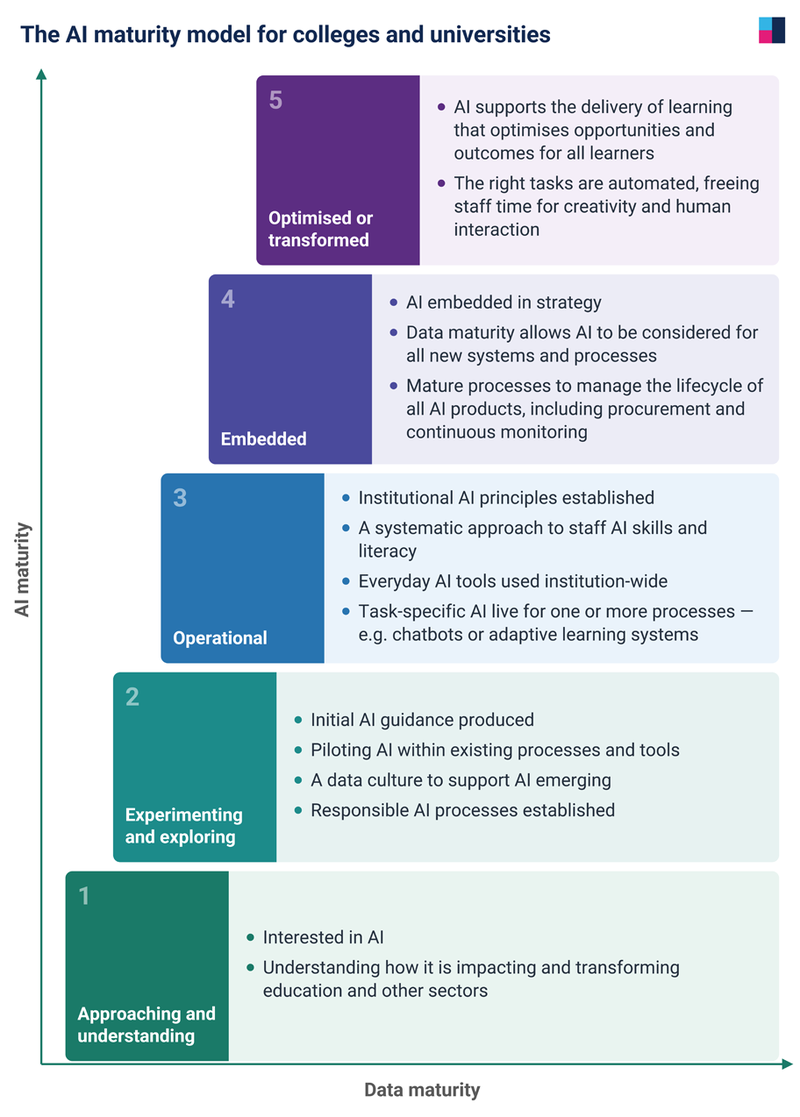
The five stages of the AI maturity model, ascending from approaching and understanding, through experimenting and exploring, operational and embedded, to optimised or transformed.
Open a larger version of the AI maturity model infographic (png).

Alt text for the maturity model graphic
The diagram illustrates five progressive stages of AI maturity for colleges and universities, from approaching and understanding AI through to optimised or transformed use.
Stage one: approaching and understanding
- Interested in AI
- Understanding how it is impacting and transforming education and other sectors
Stage two: experimenting and exploring
- Initial AI guidance produced
- Piloting AI within existing processes and tools
- A data culture to support AI emerging
- Responsible AI processes established
Stage three: operational
- Institutional AI principles established
- A systematic approach to staff AI skills and literacy
- Everyday AI tools used institution-wide
- Task-specific AI live for one or more processes, for example chatbots or adaptive learning systems
Stage four: embedded
- AI embedded in strategy
- Data maturity allows AI to be considered for all new systems and processes
- Mature processes to manage the lifecycle of all AI products, including procurement and continuous monitoring
Stage 5: optimised or transformed
- AI supports the delivery of learning that optimises opportunities and outcomes for all learners
- The right tasks are automated, freeing staff time for creativity and human interaction
Supporting foundations
- AI maturity
- Data maturity
Approaching and understanding
We have kept the approaching and understanding stage in the model, as a useful reminder of the journey we have been on. With AI now embedded in so many software tools, and used so widely by staff and students, institutions across UK tertiary education have all moved past simple curiosity about AI.
It’s worth remembering that it’s only a few short years ago that the primary activity around AI in education was trying to understand what it was, from a conceptual perspective, with little hands-on expertise beyond a few brave souls investigating adaptive learning, basic pre-generative AI chatbots, and early marking and feedback tools.
Experimenting and exploring
Whilst UK colleges and universities have moved on from the approaching and understanding stage, it is far more common for aspects of AI in institutions to be at the experiment stage.
At the ‘experimenting and exploring’ stage, institutions will have issued initial guidance to staff and students and will have started to actively experiment with AI in a systematic way. This might be through initiatives that involve using existing AI tools or piloting new ones. Understanding successful implementations of AI systems, even on a small scale, is beneficial at this stage.
At this stage, institutions will have grasped some of the main practical issues. For instance, how does AI use data? Do we have the data we need for our applications? What data concepts are important to understand and consider in our exploration? For example, understanding how bias occurs and how we can mitigate it is crucial.
To enable this, establishing an approach to responsible AI is essential. Typically, this will involve reviewing existing policies and making any necessary changes to enable responsible use of AI. This may include defining approved or recommended AI applications, for example.
Operational
At this stage, institutions will have moved beyond initial guidance to having developed a set of core principles for the use of AI within their institution and will be reviewing and updating any initial guidance to reflect these principles. AI literacy skills now become a priority and there should be a systematic programme in place. This should cover both the mechanics of using AI tools, and the skills and knowledge to use AI critically and responsibly.
The use of everyday AI tools such as Microsoft Copilot or Google Gemini will be commonplace and institution-wide. Organisations at this stage will have moved beyond just working with everyday tools and will be deploying task-specific AI tools to automate or enhance processes. This might be through procuring or enabling AI features in an existing application or through buying and deploying a new tool.
At the operational stage, institutions will have moved beyond experimentation to having AI systems live for one or more processes. Institutions will have reviewed their operational procedures and policies to ensure they cover all relevant AI-related issues. This should include academic integrity, data protection and IT-use policies, and processes around procurement and system monitoring.
Embedded
During the early part of the operational stage, AI projects are likely to be seen as special cases. However, as AI becomes more embedded, it will simply become part of the consideration for any digital transformation or technology project, underpinned by an organisation’s strategy. That strategy will clarify whether the aim is to optimise or transform the organisation.
Mature data governance will play a role, as will institution-wide policies and processes. For instance, policies for monitoring AI solutions for performance and integrity will be established at an institutional level, similar to how we see institution-wide security policies today.
At this stage, with an eye to the near future and moving towards optimisation or transformation, these policies and processes should be refined to support the use of agentic AI: deciding what to hand to an agent, what to keep human-led, and how to govern the access and oversight those agents require.
Optimised or transformed
Most (but not all) educational establishments will likely look to AI to optimise their existing approaches. This might include using AI to improve the flexibility and effectiveness of learning opportunities and remove unnecessarily burdensome processes while still providing students with the same (or very similar) qualifications.
Will we see some institutions looking to transform by delivering completely new types of learning and qualifications? At the moment, such transformation will very much be the exception.
Whether an organisation is transformed or optimised, we believe there will be two main outcomes. The first is that AI will support the delivery of learning that optimises opportunities and outcomes for all learners. This represents a more nuanced take on the idea of personalised learning. The second outcome is that the right tasks will be automated, freeing staff time for creativity and human interaction. The emphasis here is on the ‘right tasks’. Institutions should make decisions about what these tasks are for them and which should remain human-led.
This model provides the shared language used across our guides. The later stages here — operational, embedded and optimised or transformed — are the ones our implementation toolkit is built to support; leading AI well is about moving your institution deliberately from one stage to the next.