
The power of collaboration in a global digital community
Global collaboration is helping universities navigate AI, digital equity and transformation while building more inclusive and accessible learning experiences.
Author

Sarah Knight
Director, digital leadership and transformation, Jisc
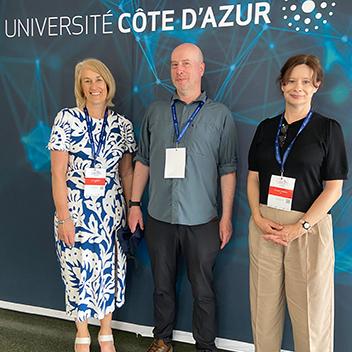
Conversations about digital transformation are becoming increasingly global. This June, Elizabeth Newall, senior sector specialist (digital transformation), Mike Cameron, senior consultant (digital capabilities) and I joined more than 300 delegates from 48 countries at International Digital Week, hosted by Université Côte d'Azur. Across five days, one message came through repeatedly regardless of session topic or country: institutions are all focused on the ways that digital and AI are impacting education. The question now is how that impact can be equitable, sustainable and centred on learners.
Global challenges
Our connection to the event began through international partnership work led by Virginie Oddo at the Université Côte d’Azur. Her team had heard about our digital transformation framework and maturity model (pdf) during its pilot phrase and asked whether if they could take part. The framework has since been used and adapted through partnership projects involving institutions including Vietnam, Mongolia and across Africa.
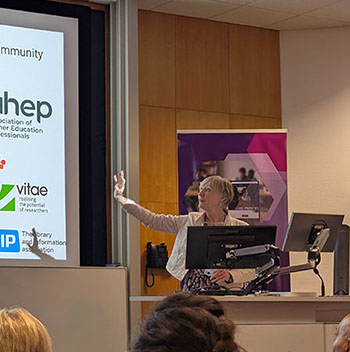
At Jisc we know that digital transformation is a global challenge, and international collaboration helps institutions learn from one another, so we’re always keen to to play our part in international discussions. This year's programme covered topics including digital leadership, AI adoption, digital equity, accessibility and curriculum design. We contributed four sessions across the event: my keynote on driving digital transformation in higher education; Elizabeth chairing an international panel on digital equity and access; Mike running a workshop on staff and student digital capabilities; and a joint workshop on our beyond blended curriculum design work.
At Jisc we know that digital transformation is a global challenge, and international collaboration helps institutions learn from one another, so we’re always keen to to play our part in international discussions.
Beyond AI
Unsurprisingly, there were increasingly critical conversations around the use of AI, but what struck me was how little of the substantive conversation was about the tools and technology.
The discussion has moved on and is now centred on people: how we can best support staff and students with ethical, effective and appropriate use of AI. At the same time, institutions are still grappling with genuine uncertainty around governance, assessment, capability building and risk.
Differences, not deficits
Some of the starkest moments during the two days involved hearing how the digital divide between Europe and Africa is growing significantly and the impact of those differences in equity and access.
In Elizabeth’s session on digital equity, Luisa Hernandez, from Uniminuto, a multi-campus university in Colombia, shared the statistic that nationally, only 35% of students have access to a large device. Figures like that, as we’ve seen in our own research on global education and technology, reframe what ‘digital learning’ even means in some contexts.
It echoed a key fact our research into transnational education has found: many students, particularly in Africa, are relying on mobile data rather than wifi, having leapt from 3G straight to 5G because that's where investment has been made. The panel's framing for this mirrors our own focus: we all need to be looking at differences, not deficits.
Another panellist, Amy Foxwell, representing ReadSpeaker, highlighted that accessibility isn't a secondary consideration bolted onto digital transformation. It has to be a strategic imperative from the start. Her position was that technology that would once have been referred to as ‘assistive’ is now called productivity technology and is seen as useful irrespective of any kind of learning difference.
Above all, given differing access to devices, challenges to connectivity and students’ time constraints, the message was that institutions must offer flexibility.
Accessibility isn't a secondary consideration bolted onto digital transformation. It has to be a strategic imperative from the start.
Learning both ways
It was encouraging to see how many of the challenges being discussed are shared across higher education systems internationally.
The discussions highlighted some of the strengths of the UK's collaborative approach to digital transformation, particularly the ability to draw on sector-wide frameworks, research and evidence. Equally important, however, was the opportunity to learn from approaches being developed elsewhere.
But the learning runs both ways. Feedback from international conversations feeds directly back into our own research and tools, and validates – or challenges – what we're doing with UK institutions. One theme that came through clearly is localisation: internationalising education can't mean simply exporting UK approaches elsewhere; it has to be contextualised to where it lands. That thinking sits behind our own recent invitation to advise on the UK government's international education strategy – a role that only makes sense if we're building genuine understanding of other systems, not just exporting our own.
I also noted that conversations with some European colleagues about digital sovereignty, and the scrutiny institutions are applying to relationships with major technology providers, felt further advanced than similar conversations in the UK. It was a useful reminder that innovation and leadership are emerging from many different parts of the global education community.
Building international community
What stood out most was not how different institutions are, but how many of their challenges are shared. Whether the focus was AI, accessibility, infrastructure or digital equity, delegates were grappling with similar questions from very different starting points. International collaboration provides an opportunity to learn from those differing experiences rather than assuming there is a single model that works everywhere.
Find out more
- Discover how to take digital transformation forward in your organisation
- Read our report and case studies on how to approach digital transformation in higher education
- Explore how our trusted frameworks, sector intelligence and expert guidance can support your digital leadership and strategy
- Join our digital transformation in higher education working group to continue to feed into our work on digital transformation and to enable cross sector collaboration
Continue reading
Sign up to Headlines
Stay at the forefront of technology in education and research with our tailored fortnightly newsletter.