
Powering the future of telecommunications research with JOINER
World-changing research increasingly depends on collaboration across institutions, disciplines and borders. Powered by the Janet Network, JOINER is enabling researchers to safely test emerging technologies and turn innovative ideas into real-world solutions.
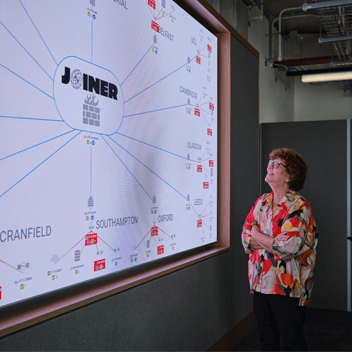
As the race towards next-generation communications accelerates, infrastructure that can support experimental technologies plays a vital part in providing a safe testing environment that could shape the future of connectivity.
JOINER (Joint Open Infrastructure for Networks Research) is a major initiative led by the University of Bristol and funded by the Engineering and Physical Sciences Research Council (EPSRC) and the Department for Science, Innovation and Technology (DSIT). Bringing together more than 15 UK and international laboratories, JOINER creates a platform that gives researchers the tools to explore complex technology challenges in a safe, high-capacity environment that mirrors real-world networks
Find out more about the JOINER platform
Investing in the infrastructure behind innovation
Underpinning it all is the Janet Network, the UK's national research and education network (NREN) and a critical foundation for research infrastructure. By securely connecting institutions, facilities, data and researchers across the UK and internationally, Janet creates the resilient digital environment needed for collaboration at scale.
Neil Shewry, our director of networks, said:
“Janet is designed and built for research and for national and even international collaboration, so we had the capability to deliver the services required by the JOINER project already. Our network is high capacity, high availability, low latency, and secure; exactly what the JOINER project required.”
Future-proofing the Janet Network is about more than just meeting today's connectivity needs; it's about ensuring the UK's research community has the infrastructure needed to develop, trial, and scale future technologies.
Solving tomorrow’s connectivity challenges
Work to improve how wireless spectrum is used is one example of the research being enabled through JOINER, helping to address growing demands on modern communications networks. Xiaolan Liu, lecturer and assistant professor at the University of Bristol, specialises in spectrum research.
For this research, understanding how the spectrum is currently used by existing technologies is a crucial first step. By analysing current usage patterns, she and her fellow researchers can identify opportunities to use the spectrum more efficiently and explore new approaches to spectrum sharing.
Xiaolan said:
“With different technologies like Wi-Fi and 5G, when they have taken some of the spectrum, it means other technologies can’t use it anymore. So it's almost like water, in that if someone uses it, it’s been consumed and is no longer available for other people.”
Improving the way the spectrum is shared could unlock greater connectivity for people and organisations, helping to deliver more reliable digital services whether people are travelling, working from home, studying, or accessing services in their local communities. Ultimately, this research aims to make better use of a finite resource, enabling wider access to high-quality connectivity.
Research into areas such as spectrum sharing demonstrates why continued investment in world-class research infrastructure is so important. As emerging technologies become increasingly interconnected, initiatives like JOINER provide the environment needed to explore new ideas and turn them into real-world solutions. By evolving the Janet Network to support increasingly advanced research requirements, the UK can continue to provide a platform for discovery, collaboration, and innovation at a global scale.
Reflecting on the wider role Janet plays in supporting UK research, Rhys Jeffs, our director of technology strategy, said:
“I think there's a perception sometimes that Janet is only there to transport data from one place to another but when we look at the comprehensive set of services that we offer, it's much more than that. It's a key enabler for research infrastructure across the UK. So everything we do, from our higher level and cyber security services to our monitoring and ability to respond to threats, is built around Janet as the central way to enable it all. So I see Janet as a core part of how we join up UK research infrastructure for the entire sector.”
Accelerating innovation from research to reality
JOINER is not only shaping future research capabilities, it's already accelerating innovation today.
Dimitra Simeonidou, director at JOINER and Smart Internet Labs, University of Bristol said:
“JOINER is already having a huge impact in the UK sector. It's really being established as the place to come and try new solutions and new technologies. Researchers across the country are demonstrating to their future customers and investors how to test a new service or a new technology before they adopt it into the real networks. So it is accelerating the pipeline of innovation in telecom technologies.”
The innovations developed through initiatives like JOINER will ultimately be relevant to far more than just the research community. As AI-based and data-oriented digital services continue to grow, the networks behind them are often invisible.
Liam Earney, our MD – higher education and research, said:
“The Janet network is so important in terms of what it enables for UK research and innovation. It also connects us to the rest of the research and innovation ecosystem globally, for research projects like the Vera Rubin Observatory, the Square Kilometre Array, and the connection into CERN, enabling huge amounts of data to be passed back to the UK to be analysed by our researchers.
The economic, societal, and health benefits that all of us want are what drives us on a day to day basis at Jisc to provide the network, to make sure that it's secure, to work with institutions in the way that we do, so that all of those programmes, intellect, and research investment have the best possible outcomes.”
Next steps
Sign up to Headlines
Stay at the forefront of technology in education and research with our tailored newsletter.